Part 107 Airspace Explained: Class B, C, D, E and G for Drone Pilots
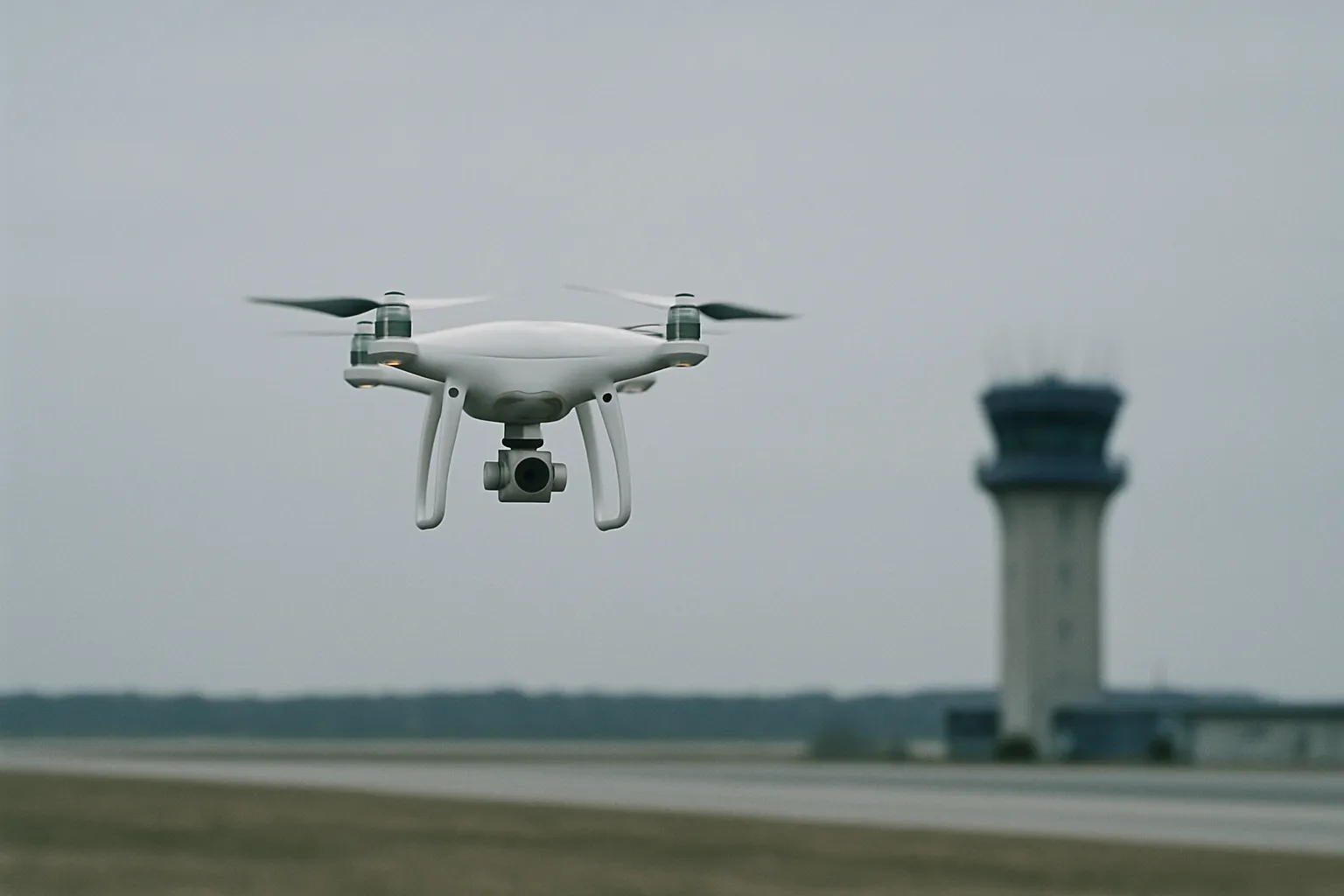
Airspace is one of the biggest topic areas on the FAA Part 107 Remote Pilot knowledge test, and it trips up more new drone pilots than almost anything else. The good news: once you understand the difference between controlled and uncontrolled airspace, the rest is mostly detail. This guide breaks down each airspace class, explains exactly when you need FAA authorization to fly, and shows how the airspace questions tend to appear on the test.
Controlled vs. uncontrolled airspace — the one distinction that matters
Almost every Part 107 airspace question comes down to a single decision: is this airspace controlled or uncontrolled?
- Controlled airspace (Classes B, C, D, and the surface areas of Class E) is managed by air traffic control. To fly a drone under Part 107 in controlled airspace, you need prior FAA authorization.
- Uncontrolled airspace (Class G) has no ATC service. You do not need authorization to fly there — but you still must follow every other Part 107 rule.
That's the whole framework. Everything below just fills in where each class lives and how to get authorized.
The airspace classes at a glance
| Class | Controlled? | Where you'll find it | Part 107 authorization needed? |
|---|---|---|---|
| B | Yes | The busiest airports (major metro hubs) | Yes |
| C | Yes | Medium-traffic airports with radar approach | Yes |
| D | Yes | Smaller airports with an operating control tower | Yes |
| E (surface) | Yes | Surface areas around certain airports | Yes |
| E (above 700/1,200 ft) | Yes | Transition airspace above much of the country | No, at typical drone altitude |
| G | No | Most rural and low-altitude airspace | No |
Class B, C and D: controlled airspace around airports
Classes B, C and D all surround airports with active air traffic control, just at different traffic levels. Class B wraps the busiest hubs, Class C covers medium-traffic radar airports, and Class D rings smaller fields with an operating control tower. For a drone pilot the takeaway is identical for all three: you need authorization before you launch.
On a sectional chart, Class B appears as solid blue lines, Class C as solid magenta lines, and Class D as dashed blue lines around the airport.
Class E: controlled, but it depends on the altitude
Class E is the airspace class students most often get wrong, because it behaves in two different ways:
- Class E surface areas extend from the ground up around certain airports (shown as a dashed magenta line). Because this controlled airspace reaches the surface, you need authorization to fly a drone there.
- Class E that starts at 700 or 1,200 feet AGL (the faded magenta and blue tints on a chart) sits above the altitudes a drone normally flies. Below that floor you're actually in Class G, so no authorization is required at typical Part 107 altitudes.
So when you see Class E on a chart, the question is always: does it touch the surface here?
Class G: uncontrolled airspace
Class G is uncontrolled airspace, and it covers most of the low-altitude airspace away from airports. You don't need any ATC authorization to fly a drone in Class G. You do still have to obey the rest of Part 107 — stay at or below 400 feet AGL, keep the drone within visual line of sight, fly in daylight or civil twilight with proper lighting, and yield to all manned aircraft.
How to get authorization: LAANC and DroneZone
When you do need to fly in controlled airspace, there are two ways to get cleared:
- LAANC (Low Altitude Authorization and Notification Capability) gives near-real-time authorization through approved apps and providers. It checks your request against the FAA's UAS Facility Maps — the published altitude grid for each area — and approves it in seconds if you're at or below the grid ceiling.
- FAA DroneZone is the FAA's portal for requests LAANC can't handle automatically: airspace not covered by LAANC, or altitudes above the grid value, which need manual coordination and take longer.
For the test, remember that LAANC is the fast, automated path and is the answer to most "how do I get authorized quickly" questions.
The 400-foot rule
Under 14 CFR 107.51, you may not fly higher than 400 feet above ground level — unless you're within 400 feet of a structure, in which case you may fly up to 400 feet above that structure's immediate uppermost limit. This altitude limit applies in every class of airspace, controlled or not.
How airspace shows up on the Part 107 test
The Part 107 knowledge test has 60 multiple-choice questions, a 120-minute time limit, and you need 70% to pass. Airspace questions usually take one of two forms:
- Chart-reading questions, where you're given a section of a sectional chart and asked which airspace class applies at a specific point. This is why recognizing the blue and magenta line styles matters.
- Rule questions, where you're asked whether authorization is required for a described operation, or how to obtain it.
The fastest way to get comfortable is to practice with realistic, sourced questions until the controlled-vs-uncontrolled decision is automatic. Our free Part 107 demo lets you try the format, and the full Part 107 prep covers every airspace scenario with explanations that cite the FAA source. If you want to see how the whole written breaks down, the test outline maps each ACS knowledge area.
Quick FAQ
Do I need authorization to fly a drone in Class G airspace? No. Class G is uncontrolled airspace and needs no ATC authorization — but you must still follow all other Part 107 rules.
Which airspace classes require authorization for Part 107? Classes B, C, D, and the surface areas of Class E. These are controlled airspace around airports.
What is LAANC? The Low Altitude Authorization and Notification Capability — an automated system that grants near-real-time authorization to fly in controlled airspace up to the published grid altitude.
How high can I fly under Part 107? Up to 400 feet AGL, or up to 400 feet above a structure if you're within 400 feet of it.
PilotWrittenPrep is independent study material built from public-domain FAA sources and is not affiliated with or endorsed by the FAA. Always confirm current airspace and rules with official FAA resources before you fly.